

Thermal Cycling Test Chamber for Solar Panels
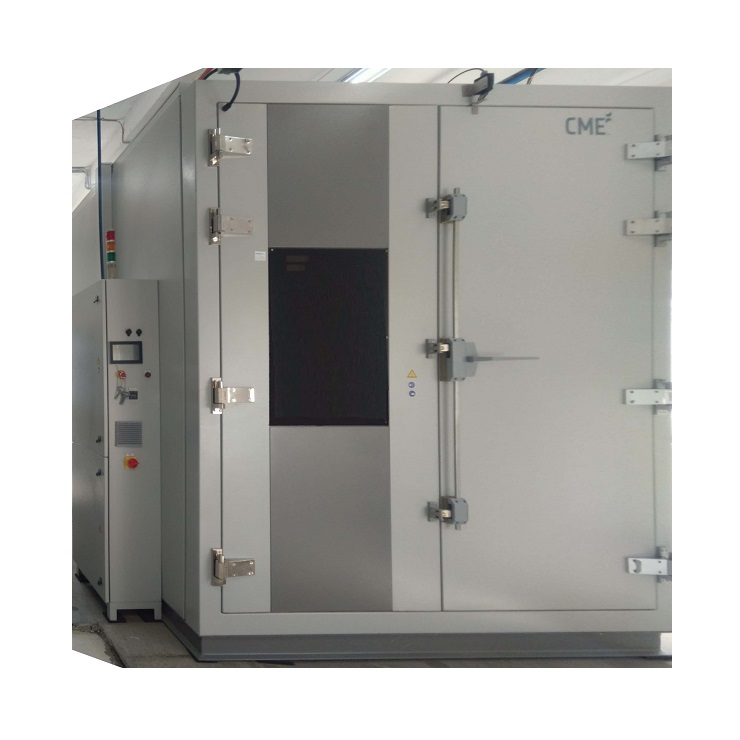
Thermal Cycling Test Chamber for Solar Panels
| Description | Specification | ||||
| Workspace Dimensions – WxDxH | |||||
| mm | 2040 | x | 2400 | x | 2400 |
| In | 80 | x | 94 | x | 94 |
| Volume | |||||
| Ltr | 11750 | ||||
| Cuft | 415 | ||||
| Temperature Range | |||||
| °C | -40 | To | 100 | ||
| °F | -40 | To | 212 | ||
| Ramp Rates | |||||
| Cooling °C/min | 2 | ||||
| Heating °C/min | 2 | ||||
Description
Thermal Cycling Test Chamber for Solar Panel Reliability and Environmental Stress Testing
Advanced Thermal Cycling Test Chamber for Photovoltaic Module Testing
The Thermal Cycling Test Chamber for Solar Panels is a high-performance environmental testing system designed to evaluate the durability, reliability, safety, and long-term performance of photovoltaic (PV) modules under repeated temperature fluctuations. This advanced thermal cycling chamber simulates extreme environmental conditions by cycling temperatures between high and low limits to identify hidden defects and long-term failure risks in solar panels.
The Thermal Cycling Test Chamber is widely used for photovoltaic module reliability testing, accelerated aging analysis, environmental stress testing, thermal shock evaluation, and solar panel durability validation in solar manufacturing facilities, renewable energy laboratories, certification centers, and research institutions.
Thermal Cycling Testing for Solar Panel Durability Validation
Solar panels are expected to operate reliably for more than 20–25 years in outdoor environments where they are continuously exposed to:
- Day and night temperature changes
- Seasonal climate variations
- Extreme weather conditions
- Thermal stress and expansion cycles
Since long-term outdoor testing is time-consuming and impractical, accelerated thermal cycling tests are performed in controlled laboratory environments to evaluate solar module reliability and long-term durability.
The Thermal Cycling Test Chamber reproduces these harsh environmental conditions by rapidly cycling temperatures between:
- -40°C low-temperature conditions
- +85°C high-temperature conditions
This process simulates years of environmental exposure within a shorter testing period.
Detection of Hidden Defects and Material Failures
The Thermal Cycling Test Chamber helps manufacturers identify critical failure modes and material weaknesses in photovoltaic modules, including:
- Micro-cracks in solar cells
- Solder joint fatigue
- Delamination of module layers
- Insulation failure
- Thermal stress damage
- Electrical interconnection failure
- Material expansion mismatch
- Performance degradation
These tests help improve solar panel quality, increase module lifespan, and reduce the risk of field failures after installation.
Realistic Environmental Stress Simulation for Photovoltaic Modules
The chamber accurately simulates thermal expansion and contraction effects between different photovoltaic materials such as:
- Glass layers
- Silicon solar cells
- Encapsulation materials
- Electrical interconnections
- Backsheet materials
By reproducing real operating conditions, the Thermal Cycling Test Chamber allows engineers to analyze long-term material stability and environmental durability.
Compliance with International Solar Testing Standards
The Thermal Cycling Test Chamber is designed to comply with major international photovoltaic testing standards, including:
- IEC 61215
- IEC 62892
- UL testing standards
- ASTM environmental testing standards
This ensures reliable, repeatable, and standards-compliant photovoltaic testing for product certification, quality assurance, and research applications.
Precision Temperature Control and Uniform Testing Performance
The Thermal Cycling Chamber features advanced environmental control technology to provide:
- Accurate temperature cycling
- Fast temperature transition rates
- Uniform chamber temperature distribution
- Stable environmental conditions
- Repeatable testing performance
- Reliable long-duration operation
These features ensure highly accurate thermal stress simulation and consistent photovoltaic module testing results.
Applications of Thermal Cycling Test Chambers
The Thermal Cycling Test Chamber is widely used for:
- Solar panel reliability testing
- Photovoltaic module aging analysis
- Environmental stress testing
- Thermal shock testing
- PV module durability validation
- Renewable energy product testing
- Solar panel quality assurance
- Accelerated environmental aging studies
- Photovoltaic certification testing
- Research and development testing
Industries using thermal cycling chambers include:
- Solar panel manufacturers
- Renewable energy companies
- Research laboratories
- Environmental testing facilities
- Certification agencies
- Quality assurance departments
Key Features of Thermal Cycling Test Chamber for Solar Panels
- Rapid temperature cycling capability
- Temperature range from -40°C to +85°C
- Photovoltaic module environmental testing
- Accelerated aging and durability testing
- Micro-crack and delamination analysis
- Thermal stress simulation
- Uniform chamber temperature distribution
- Fast heating and cooling performance
- Long-duration reliability testing
- IEC-compliant photovoltaic testing
- Advanced environmental simulation system
- Stable and repeatable testing performance
- Industrial-grade chamber construction
- High-precision temperature control
Benefits of Using a Thermal Cycling Test Chamber
The Thermal Cycling Test Chamber helps manufacturers improve solar panel reliability, validate long-term outdoor performance, reduce product failure risks, and ensure compliance with international photovoltaic testing standards. By simulating years of environmental exposure in a controlled laboratory environment, the chamber accelerates product validation and improves overall photovoltaic module quality.
Its advanced thermal cycling technology, precise environmental control system, and standards-compliant testing capability make it an ideal solution for solar panel manufacturers, renewable energy research laboratories, and photovoltaic product testing facilities.


Reviews
There are no reviews yet.